Thursday, July 3, 2025

The Mental Health Care Shortfall in New England

The Health Resources and Services Administration (HRSA) can designate a population group, facility, or geographic area as a health professional shortage area (HPSA) for mental health care services. This designation indicates that there is a mental health care services shortfall in the community because too few mental health care practitioners service the area relative to the size of the population. From March 31, 2025 HRSA data, more than 122.4 million Americans live in a mental health care HPSA. That number included 1.8 million residents of the six-state New England region. To eliminate that mental health care shortfall, the HRSA estimates that HPSAs in the region would need 90 additional mental health care practitioners.  A further review of 3/31/25 HRSA data details the following about the state-level mental health care shortfall in New England:

The Mental Health Care Shortfall in New England

The Mental Health Care Shortfall in New England

State (1) HPSAs (2) Population (3) Shortfall
CT 43 801,604 53
ME 65 268,713 11
MA 51 256,453 13
NH 18 91,279 2
RI 12 394,307 11
VT 12 N/A N/A
Region 201 1,812,356 90
U.S. 6,418 122,383,988 6,202

(1) HRSA-designated Geographic Units, Population Groups, and Facilities with a mental health care shortfall
(2) Population of designated HPSAs
(3) Mental Health Care practitioners needed to remove HPSA Designation

Source:  Designated HPSA Quarterly Summary, March 31, 2025 (HRSA)

Wednesday, July 2, 2025

The Primary Care Shortfall in the Far Western U.S.

A primary care health professional shortage area (HPSA) is a designation given by the Health Resources and Services Administration (HRSA) to a population group, geographic area, or facility where residents have limited access to basic medical care because not enough primary care physicians serve the area relative to its population size.  As of March 31, 2025, the HRSA reported that more than 77.2 million Americans lived in a community that had a primary care shortfall.  Per HRSA data, the six-state Far Western U.S. was home to nearly 11.8 million Americans who lived in primary care shortfall areas.  The HRSA estimates that to eliminate this shortfall, HPSAs in the Far Western U.S would need 1,922 additional primary care physicians.  A closer review of 3/31/25 HRSA data reveals the following about the primary care shortfall in the Far Western U.S.:
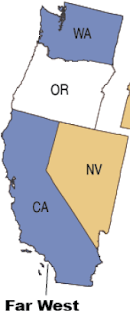
The Primary Care Shortfall in the Far Western U.S.

The Primary Care Shortfall in the Far Western U.S.

State (1) HPSAs (2) Population (3) Shortfall
AK 343 288,772 71
CA 630 6,549,786 971
HI 33 519,572 87
NV 74 952,427 183
OR 150 877,420 111
WA 214 2,606,632 499
Region 1,444 11,794,609 1.922
U.S. 7,749 77,253,848 13,364

(1) HRSA-designated Geographic Units, Population Groups, and Facilities with a primary care shortfall
(2) Population of designated HPSAs
(3) Primary Care practitioners needed to remove the HPSA Designation

Source:  Designated HPSA Quarterly Summary, 3/31/25 (HRSA)